Happy Birthday Hadley
August 22, 2018
Thinking about 2011
August 22, 2018
What Do you Wear To A Bullfight?

What Do You Wear To A Bullfight?
Or, My First Corrida
I’ve been home for several weeks now and to be honest, I sort of crash landed back into my own life. I attribute this partly to the phenomenon of flying, which enables one to be on the lively coast of the Spain one night, (staying out much too late on the night before an early morning flight) and at home in our own beds the next. Which leads me to wonder: was I just dreaming? Was that tapa bar, buzzing with music and conversation after the bullfight real?
It is also my own fault for trying to pack in as much experience as possible into my last few days. On our very last night in Spain, I went to my first bullfight during the feira in Malaga, the biggest festival of the year. We were lucky to get tickets during that week, since Rivera Ordonez, the grandson of Antonio Ordonez, as well as the much loved, very young torero, Daniel Luque were both on the bill that evening. I have been trying to write about my experiences in Spain for several weeks now, especially this bullfight, but I find that even when I am speaking about it, my feelings are too big, too unordered to tell it in a logical way. When I told a librarian friend of mine that I was having trouble writing about the bullfight I had seen, she said, “Well, you were stirred in a primal way.” Without skipping a beat, another woman walked by and said, “What better way to be stirred?”
I could begin the story of Spain by telling you about the little villages where we stayed, about how blue the ocean was, the kind of color it was – an infinite blue that I’ve tried to burn into my memory forever. Cerulean, incandescent, an intense cobalt blue that connects you to the ancient Greeks, to Icarus and his spectacular flight and epic fall, to a wide golden light and the splashing plunge of water – a no-wonder-Van-Gogh blue.
Or I could write about how much I loved the plazas all across the country and the sound of goat bells ringing up and down the hills, or about the way the light is luminous in Spain in different ways throughout the day and into the evening. But before I can focus on explaining any of those things, an image flashes through my mind –a glimpse of something deeply embedded in me – a fragment of something – a red and white blur. I pause for a moment and pull it into my consciousness – is it a memory? Is it a dream? No, it’s Pamplona, and I was there last month!
You see, I am “ass over teakettle” as the British say, (which the slang dictionary defines as,“fallen in a dramatic fashion”; or, ‘in complete disarray’), and have been for a couple of weeks now. Way too many big things have happened in my life this year –
So perhaps I should back up and do this Hemingway style. I will tell you about my last evening in Spain by simply reporting to you what happened. In this deceptively simple way, perhaps I can climb out of the wild jumble of my experiences – word by word, detail by detail – and make a little bit of order out of a lot of chaos. I’ll pretend that I’m Ernest and you can pretend that you are reading the Toronto Star.
By the end of August, Spain was intensely hot. I have never experienced heat like this, bearing down on us as if the sunlight had a weight of its own. I can see how light like this can eventually crumble rocks and cathedrals, it was that hot. The heat was something that you eventually take pleasure in because it’s so remarkable, so much a part of the experience of Spain. Throughout July we had traveled up and down and back and forth in Spain and oh how I loved the plazas, the fountains, the tiled and cobbled streets, the curving mountain roads with hair pin turns and thrilling views – all of it new and old and sleepy and full of vitality all at the same time. But the way the heat came in August slowed everything down.
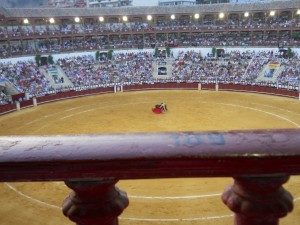
So back to the bullfight – I mention the heat because the sun is such a feature of the evening in my memory. I asked a few of my female friends ahead of time what one wears to a bullfight, which was really another way of saying that I really didn’t know what to expect. No one could actually answer that question, but because of the heat, we wore the lightest clothing we had. The audience seemed to be mostly older Spanish people and quite a few foreigners. The bullring was timelessly beautiful, with red railings and window arches, and a grace and pageantry that does not exist in any other arena I’ve been in.
It was our last day in Spain and we took an early bus from our little village of Maro into Malaga, a beautiful and surprising city next to the sea. We spent the day walking through the streets and along the beach telling ourselves how much we have loved this summer of our lives, marveling at the setting we were in and the people around us. We ordered our last paella for the summer, and drank the last brisk cold Spanish beer. The streets of Malaga were wrapped in ribbons and flowers, music drifted through the air, there were horses, musicians, dancing, free beer and tapas, and bullfights each evening. The streets had vitality and tiredness too, (the undercurrent of all great parties, the sense that this would end) for today was the last day of the fair and the end of the summer and our last full day in Spain.
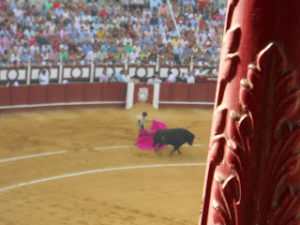
As we got closer to the time of the bullfight, we spent a couple hours at a café near the bullring and watched what was happening around us. The café grew noisy with the happy chatter of Spanish people as the time for the bullfight drew closer; women wore long flamenco dresses, despite the heat. From our table, we could see men come and go through the back doors of the arena; we took turns walking across the street to the bullring to see if we could see anything. At one point we could smell and hear the bulls on the other side of a wall; the bulls had a familiar animal scent – which was somehow oddly touching. Finally, the day was fading, the sun was a burnt orange globe in the sky, but the heat stayed strong.
Just before 7 pm we crossed the street and entered the arena. In the umber light we watched the bullring fill with spectators, many with their own gold and red seat cushions and folding fans to help with the heat. There was a tired buzz in the air; hot tired streets and afternoon wine. From where we sat, we could see the ruins of an old fort to the left of us and new high-rise apartments to the right. A man with an Adonis Greek figure was sunbathing on his balcony, his eyes closed. He seemed nonchalant to the sounds of the bullring below, which he must hear every night. As people filled the stands in the bullring, a murmur rose around us but it was in another language, and we were too tired to distinguish it. Someone walked by selling cold beer. This was Malaga – this was Spain in a microcosm, the fiesta, the heat and the throb of a foreign language in the background, an old drama played out anew.
The band started up – a real band sitting nearby in the balcony – and their music signaled the beginning of the evening, adding a kind of pageantry as each figure, each character of the drama was introduced to the audience – the picadors, the toreadors, etc. . . Dusk came on and highlighted the color of the sand in the ring, the deep red arches around the arena, the costumes the participants were wearing, the brass horns gleaming in the band section in the evening light.
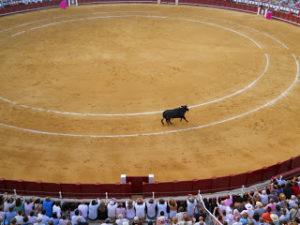
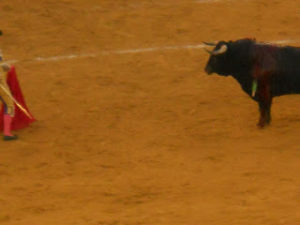
The first toreador threw his hat into the ring to see which way his luck would go and the night began. The bulls come out high-spirited, bold, and noble. They are sleek and strong and dark and beautiful and it all begins. My son liked the way the bulls were frisky before the picadors bled them. The horses are also beautiful in a different way than the bulls; graceful, fluid. The scene was riveting. We were holding our breath and looking at each other with wide eyes as the three acts unfolded before us – before we were ready, before we knew what we thought. It was beautiful, it was dangerous, and it was disturbing.
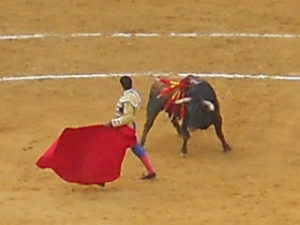
There was so much to absorb that it is hard to describe, the rich red flash of the cape, the glint of the sword in afternoon light, the deepening shadows in an ancient bullring, the hush and the murmur of hundreds of people watching life and death, graceful men in their colorful suit of lights, the magnificent bull trotting, charging and almost dancing around the men in the ring – a black swirl, a blur, a kaleidoscope of Spanish color.
The first bull did not die right away but staggered sideways for what seemed like an eternity before finally falling. (If any of you have seen Gerard Depardieu in Cyrano de Bergerac, think of the last scene in the garden before he utters “my panache –“.) Both of us were rather shocked – it was fascinating, it was beautiful, it was brutal, elemental and intense. And our adrenalin was up – way up. It remained that way all evening (and unfortunately, in our beds that night when we had hoped for some sleep).
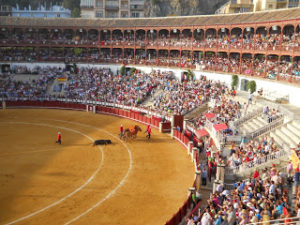
After the bull dies, “the death squad”, as my son calls them, moves into the ring with a team of horses that drag the bull’s body out of the ring. Then a group of men sweep away the blood and rearrange the sand – the team of horses wears bells that jingle in an oddly cheerful way as they go in and out of the ring to do their job. The music stops for this and you notice how intense the heat is and the air is still except for the paper fans going back and forth in the sweltering August night.
I’m not sure either one of us knew what to expect, but after the first fight we were able to watch the second fight in a different way. I noticed how each person had a job to do and how important it was that they do it well. I noticed what the picadors do (and thought they were rather brutal).As the evening went on I saw how each bull was different and how the men in the ring learned and responded to him. I was able to pull my eyes away and watch the audience and the people around me. I understood some of what Ric Polansky explained when he described the audience as being part of what makes each bullfight new. The spectators have their own rituals and expectations as they participate in the evening in subtle and not so subtle ways. I could understand how easy it would be to write about bullfights in a romantic, cliché way or resort to technical observations, because a bullfight is not like a movie that you can easily forget, it is something you think about for a long time. I remembered the shopkeeper we met our first week in Mijas: bullfighting was cruel, he acknowledged, but “life is cruel, no?”
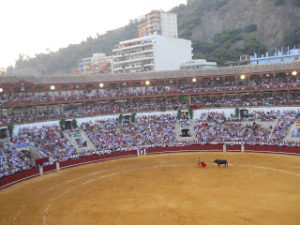
The young matador Daniel Luque cut an ear that night, and the crowd went crazy. White handkerchiefs went up all around the arena. A few rows behind us, a Spanish woman a little older than me was overcome with emotion during the last fight. She yelled all evening, but during Luque’s fight she shouted, Kill him good, hombre! Gradually she moved closer and closer to the railing where we sat until finally she was leaning into us, cheering on the matador, obviously moved by the events of the evening. Her passion for bullfighting was so intense that after the bullfight I asked her why she loved it so much. Es muy bonita, she said – it’s beautiful. She knew and felt deeply the traditions and rituals of bullfighting, of her own culture, the heroic ideals that played out before us in the ring that evening. The bullfights were over and the young bullfighter walked around the ring accepting accolades, flowers, and gifts. We exhaled. The crowd emptied out of the arched exits and into the streets. We walked out of the building with the woman and her husband, my son translating for us.
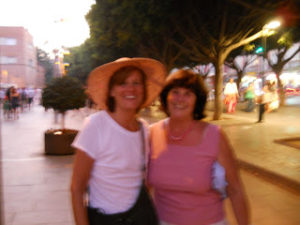
She led us around the bullring to show us the pens where the bulls wait before the fight and where they are butchered afterwards. It was dark now and from where we stood, we could see light coming from the room where they had taken the bulls, there was a small river of blood outside the door. We asked many questions and she was clearly delighted to talk about bullfighting and her country. She has loved bullfighting all of her life, the ceremony of it. She knew about all of the toreros past and present. She told us about their style, their glorious posture, their achievements and their travel schedule throughout the country. We stood int he street talking, strangers really, but we could not let each other go – Together, we walked to the corner, stopping at a vendor’s table where she bought several expensive portraits of the toreros she loved. Her enthusiasm was charming; but finally, we thanked her and said good night.
In the dark we walked almost twenty blocks, the streets sticky with beer. The feira was over and the tired vendors were packing up their stalls. We could no longer hear the accordion music that drifted around street corners most evenings in Malaga. The ocean was a dark puddle to our left, taxis slid quietly by on the street next to us. We were tired and wired, tomorrow morning we would be on a plane headed home. One of us would start to talk about the evening, unable to finish even the simplest thought or sentence. I know. . . the other would acknowledge in the dark. We tried to speak but it was only images that occurred to us, elemental colors and shapes.
After the bullfight we went to a tapa bar and had our last, lovely meal at a table on the street, reminding us that when words fail, there is always garlic!
We left Malaga at 11:00 at night, the streets still bright and noisy, and headed to Maro, an hour by bus. We had to be up at 5:00 am for our long flight home. During the drive, we saw the moon reflected back to us on the Mediterranean, not its usual dazzling blue, but jet black in the warm summer darkness. One of us would begin to talk about the bullfight again and then just simply sigh. The other answered, “mmmm” and we moved along in the gloom. It was beyond words.
We might say – “It was beautiful, in a strange way.” Or, “It was intense. It was very Roman.“ It fit exactly into the beauty and the glory and the history that is Spain. At 3 am we were still awake, laying without sleep in the darkness. It was the adrenalin.
Before we knew it we began a long, exhausting, blur of a day starting at 5 am with a talkative cab driver who loved bullfights. We had early morning coffee in a café. At the airport I stepped on a scale that measured me in stones. Our flights were from Malaga to New York City, New York to points west. As we met strangers on the plane and in the airports throughout the day, we told them we were coming back from a summer in Spain, that the ocean was a dazzling color of blue, that we were tired and happy, that we had seen a bullfight the night before.
And that was all we could say *
November 28th, 2011
Filed under: Bullfighting , Malaga
Post tags: feature
20 Comments
- Joe
- What a thrilling memoir of your first bullfight! It reads very personal and also as if the reader lived it. That’s when you know you’ve got it right. Great job, Allie! Maybe you should look into getting this published in the NY/Chicago/LA Times or something? Or maybe even Toronto! You write a very well-crafted descriptive narrative. I feel exhausted having lived your words. But also wired.
- Nikon
- Like Joe, I feel exhausted & wired by your story. So, a job very well done, Allie.
My impression is that the point of the story is trepidation – “Do I really want to do this?” “I must to fully understand Hemingway.” You are to be commended for experiencing the primal scene, not knowing where your emotions were going to take you.
Your description of the pervasive heat makes me feel it too, & wonder if I could endure it. - Rich
- Honestly Allie, I was knocked out by your story. Great job ! Even though Ernest never went to Chile, I would love to read some of your descriptive observations of your up-coming times there from your Ernest perspective.
- Andrew Levingston
- wow, what a great post Allie, for a person that has never gone to a bullfight that was a real treat. your description was amazing I feel as if I WAS REALLY THERE WITH YOU. Keep up the great work. My favorite post yet
- Matt
- You’re so blessed to travel Allie, and we appreciate you bringing your writer’s eye and mind along with you so we can share in to your travels and insights. I thought it is interesting how, you get the sense that bullfighting has really changed to much since the days of Hemingway, as if it’s been a well-preserved tradition despite the vast advances in technology. Or maybe not? Any thoughts on how it might compare to a bullfight Ernest and Hadley went to? Thanks!
- Tavarua
- Brilliant blog.
- Ric Polansky
- I like this story…clean, clear and no phony words. Lots of Hemingway honesty and most certainly in the telling of it.
Bravo! - Jeff Ramsey
- “One of us would start to talk about the evening, unable to finish even the simplest thought or sentence. I know. . . the other would acknowledge in the dark. We tried to speak but it was only images that occurred to us, elemental colors and shapes.”
Ole el arte! Allie you captured the moments perfectly, the fiesta brava is the last great art form; for those that condemn it, or ignore it are missing out on the most profound emotions a participant can expereince. You capture the essences of the corrida fluidly & perfectly.
I was turned onto your WEB page by amigo & superb aficionado Ric Polansky, thankfully there are poeple like you that can fully comprehend and appreciate the arte de Cu’chares, keep up the wonderful writing.
Ciao,
Jeff - Allie BakerThank you so much for your comment. Your thoughts on this subject mean a lot to me. I don’t know if you remember, but we met in Mojacar, Spain in 2011, and I will never forget our conversation about los toros.http://www.thehemingwayproject.com/bullfighting-hemingway-and-history-from-a-spanish-perspective-an-interview-with-paco-pereda/
- Allie
- You might also enjoy this interview, which is a Basque University Professor’s interpretation of tauromachy.Spain has affected me deeply.
- Dear Jeff,
- Jeff Ramsey
- Dear Allie: I certainly do remember our conversation on the patio at Ric’s home!
You and your husband were most delightful to talk with.
Cheers,
Jeff - JasonKeep up the good work.
- Great blog, captured the bullfight brilliantly. I saw my first corrida just a month ago and have to agree when Hemingway summed it up by calling it a “wonderful nightmare”
- Tim
- Very interesting story. But also quite disturbing for me. Maybe I’m old fashioned but I’m still always shocked when a woman candidly admits that she likes to watch violent spectacle. That most men like to watch violence seems normal for me but the fact that women can like it as well always pulls me up short. Yet of course there is no reason why they shouldn’t. Maybe its because the female of the species is traditionally seen as the life givers and nurturers. So the idea that women may enjoy watching males – bulls and matador – fighting and killing is kind of disturbing. Maybe it was the same back in ancient Rome when women would go to watch gladiatorial fights and cheer with the best of them.
Some girls I’ve known have admitted enjoying boxing and UFC fights. I also read recently an interesting interview with the American actress Juliette Lewis who said that watching two men fight each other was one of the most beautiful sights she’d ever seen.
I’m been to Spain but I have never been to a bull fight and quite frankly I doubt if I ever will. I don’t think I could stand all that bloodletting. Although aficionados of the sport argue – and rightly in my opinion – that if people object to that then they should pay a visit to their local abattoir and see how animals are killed to stock up our supermarkets. It’s a good argument.
The only way I think I could bring myself to go is if there was a guarantee that the bull would be killed as quickly as possible. But of course that cannot be guaranteed – which recalls a story told by another actress – Ingrid Pitt – in her memoirs. She went to her first bull fight full of enthusiasm and excitement but unfortunately the bull didn’t die easily. In fact it died in agony – the sword instead of going into its heart – went into its lungs. The animal was staggering round the arena bellowing and spewing blood from its mouth. Miss Pitt ran out of there screaming in horror. If I’d seen something like that I think I would be having nightmares for months afterwards.
As a parting observation a friend of mine told me that maybe I was afraid to go a bullfight because – far from being horrified by it – I might find that I liked it so much I would become addicted to it! Ouch! - Allie BakerThank you for your comment. I know what you mean about the violence and bloody nature of the bullfight. I assure you that I was also initially horrified. I avoid movies with graphic depictions of violence and am in no way attracted to cruelty in all forms (and definitely notboxing!).If we get back to Europe this summer, we plan on watching “bloodless” bullfighting, or bull leaping, which is fairly popular in Portugal and France. I’m sure it is easier to watch than a typical bullfight.
- All the best, Allie
- My tolerance and eventual fascination with bullfights is surprising to myself. I can only attribute it to my love of all things Spanish particularly as it pertains to culture, literature, and ancient traditions. The “duende” connected to bulls in Spain is unique and almost palpable. Garcia Lorca wrote about it referring to the sense of the mysterious found in the rituals of flamenco, gypsies, bulls and even in the country’s geography. He said, “The bull is the greatest poetic and spiritual treasure of Spain”. Picasso also incorporated images of bulls into his work and had plenty of what the Spanish called “duende”. The culture of the bull goes back centuries and is a part of what sets Spain apart from the other intriguing cultures in Europe.
- Dear Tim,
- Tim
- In response to your response let me add some comments. In regard to watching violence in movies I have mixed feelings (check out Tarantino’s latest offering Djange Unchained if you want to see some ‘enthusiastic’ blood letting!) but in the end it doesn’t bother not nearly as much as bull fights or cock fights. For the simple reason that – as nasty as the violence may get in a film – its still only a movie where nobody really gets hurt and the stunt men earn good money. But with a bull fight its the real deal.
Although I don’t care for boxing again I don’t object to it as much because nobody forces these guys into the ring – or into a cagefight for that matter – its their choice. But the same cannnot be argued for bull fights or any other blood sport. I often fantasise what the bull would say if it were endowed with speech and reason. Would the animal really say ”Yer right on – bring on the matador!”. I doubt it! It would probably take one look at the cheering crowd and say ”Sod duende! Get me out of here!”. And who would blame it!?
Picasso and bulls – yes there are bulls by the dozen in his works. One of the cruelest paintings he did was of a bull about to get the sword. On the bull’s face is a look of total stupidity which doesn;t invite any kind of compassion but only contempt from viewer! Nasty! I hasten to add that this wasn’t usually the case. Mostly Picasso depicted bulls as animals of great courage and nobility.
Picasso also had great compassion for the picador horses ( which he tended to see as female in contrast to the obvious maleness of the bull). Sometimes these horses get disembowelled by the bull’s horns and their death is frightful. Picasso depicted such ‘accidents’ with great compassion in his paintings.
Were there any famous authors against bullfights? One springs to mind – D.H. Lawrence. I can’t remember the novel but there’s a scene where his heroine goes to a bull fight and hates it. She then proceeds to tear apart the cultural pretensions of the sport including the ”manliness” of the matadors. But his reaction is hardly surprising as Lawrence famously loved animals.
Hope you enjoy your holiday in Europe next summer. Tim - michael
- I love bullfighting. I loved my first bullfight even though it was bad and cowardly and they ruined the bulls. I support bullfighting 100%. I watch it on the internet often. Cowardly bullfighters deserve to be booed, it is part of the experience. But what they are doing in Cancun is a disgrace and is bad for the future of bullfighting. They are hurting the corrida in Cancun.
- Lee
- Allie: Thank you for this article. I recently returned from a two week trip to Spain and am still processing the experience. I attempted to write to my email buddies about two days where I attended corridas in Sevilla (Sept 26 and 27). We secured seats in the barrera immediately behind the burladeros where the matadors enter the ring. Intensity would be an understatement for my experience. One part of me screamed “this is wrong.” Another part begged me to “shut up and just watch without judgment.” The latter voice won in the end. Indeed I experienced something primal and deep in the passion of those seated around me. Your essay captures so much of what I felt. I really needed to find a voice that could assist me in processing my emotions and thoughts from this experience. I daresay you have captured my own experience in such an eloquent way. Thank you.
- Allie BakerThank you so much for reading the blog and for commenting. Bullfighting will always be controversial. and differing opinions abound. But it seems as if all three of you approached the subject with an open mind. If you get the chance, you may be interested in reading my interview with Allen Josephs entitled, “Ernest Hemingway and Allen Josephs: Coming of Age in Spain.” In the interview, Allen describes the origins of bullfighting and why the ritual was so deeply embedded in early Mediterranean cultures. This information is fascinating, and helped me to appreciate bullfights from a deeper perspective. Thank you again for your comments!
- Fondly, Allie
- Dear Jason, Michael, and Lee,
- Johnson
- The expression “ass over teakettle” is absolutely not a British expression. Probably Canadian.
- Johnson
- “Ass over teakettle” is absolutely NOT a British expression. Probably Canadian.
- The Bullfighting Post | The Method Reader
- […] you want a different experience, here’s another Hemingway fan’s first impression of the bullfight, also in […]